
No products in the cart.
Return To Shop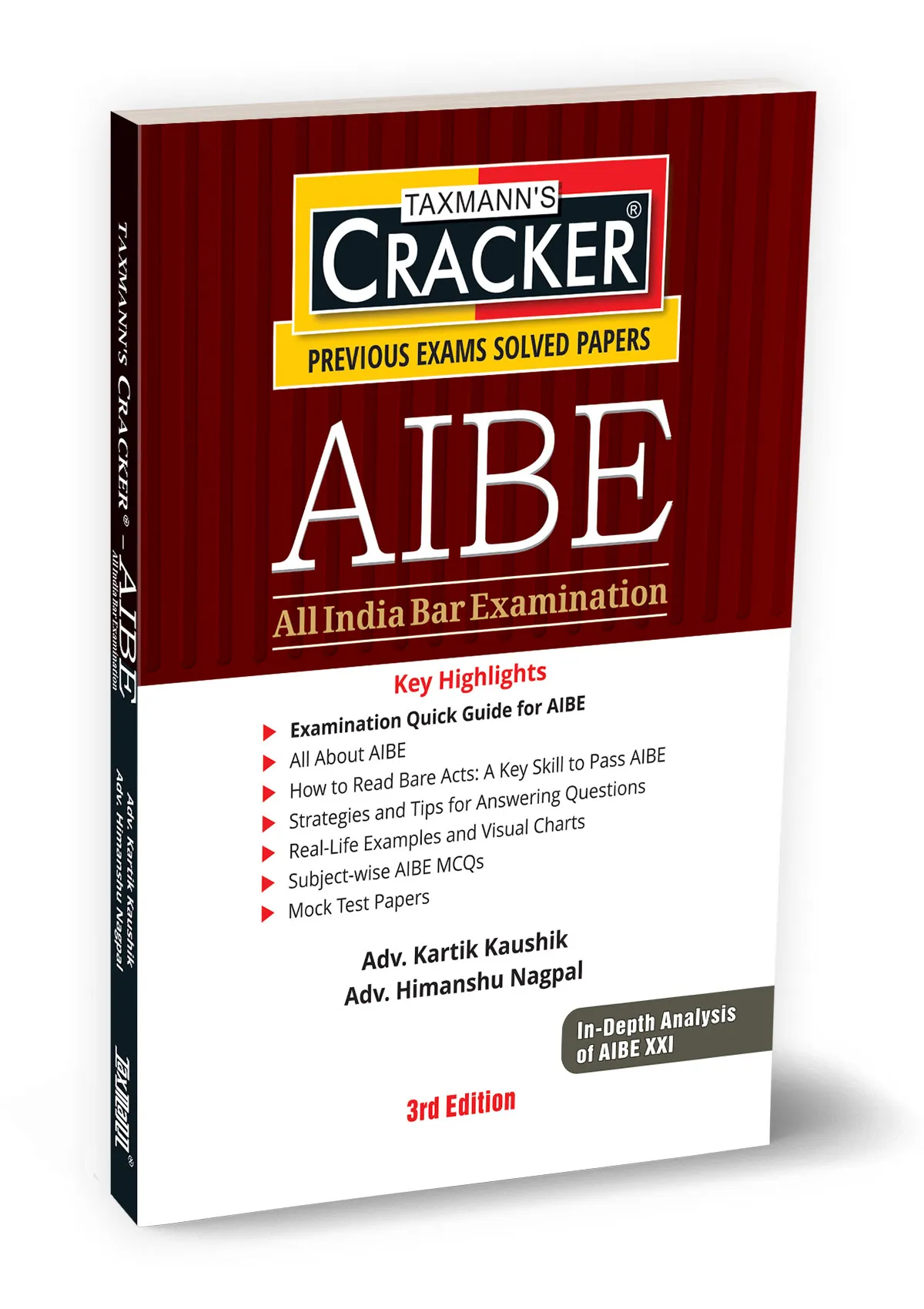
Taxmann’s AIBE All India Bar Examination CRACKER By Kartik Kaushik, Himanshu Nagpal 3rd Edition September 2026
Original price was: ₹545.₹381Current price is: ₹381.
The AIBE is an open-book paper, which is precisely why candidates fail it: with 100 questions in three hours, you have ninety seconds to find a provision, not to learn it. Taxmann’s CRACKER is built around that constraint, teaching the Bare Act as an instrument to be navigated through a single descending ladder from Act to Chapter to Section to sub-section to proviso to Explanation. Around it sit 1,162 past questions from AIBE X to XXI, each tagged to the paper that asked it; the judgments and doctrines that decide the hardest quarter of the exam; and three mock papers, with AIBE XXI broken down question by question into Easy, Medium and Hard and turned into a Three-Pass attempt order. The old codes run alongside the new throughout, each IPC provision named alongside its BNS counterpart, while Taxation, Labour and Consumer law are written to the Income Tax Act 2025, GST 2.0 and the four labour codes. 3rd Edition | 2026, by Adv. Kartik Kaushik and Adv. Himanshu Nagpal, timed for AIBE XXII on 29 November 2026.
AIBE CRACKER By Kartik Kaushik, Himanshu Nagpal Edition 2026
AIBE CRACKER By Kartik Kaushik, Himanshu Nagpal Edition 2026
Description
AIBE – All India Bar Examination | CRACKER is a complete preparatory system for the AIBE conducted by the Bar Council of India, which a law graduate must clear to obtain the Certificate of Practice and appear independently before any Court, Tribunal or legal authority in India.
Its organising insight is that the AIBE is an open-book paper of 100 multiple-choice questions in three hours, and that candidates therefore fail for a reason peculiar to open-book examinations: not because they do not know the law, but because they cannot reach it inside the ninety seconds a question allows. The book closes that gap. It treats the Bare Act as an instrument to be navigated rather than a text to be read and builds the candidate’s method around one descending search ladder, from Act to Chapter to Section or Article to sub-section or clause to proviso to Explanation.
Around that method, it assembles four further layers. It converts twelve past AIBE papers into a consolidated, subject-wise body of tested law in which every question carries the examination that asked it, so that revision follows the examiner’s demonstrated priorities rather than the full syllabus. It supplies the conceptual material Bare Acts cannot supply, namely landmark judgments, doctrines and maxims, which is where the hardest quarter of the paper is set. It analyses the most recent paper, AIBE XXI, question by question against a stated difficulty scale, and converts that analysis into an attempt order. It also provides three full-length mock papers, graded from the legacy pattern to the pattern as it now stands.
The Edition is written against two live transitions. The first is the movement of Indian criminal law from the Indian Penal Code, the Code of Criminal Procedure and the Indian Evidence Act to the Bharatiya Nyaya Sanhita 2023, the Bharatiya Nagarik Suraksha Sanhita 2023 and the Bharatiya Sakshya Adhiniyam 2023; the book carries both sets in parallel and identifies the corresponding legacy provision at the point of use, so that a question asked years ago under the IPC remains usable today. The second is the statutory turnover across the rest of the syllabus, most notably the Income Tax Act 2025, GST 2.0 and the four consolidated labour codes.
The Edition is timed for the AIBE XXII cycle, for which the Bar Council has notified the examination on 29th November 2026, with registration closing on 27th October 2026.
The Present Publication is the 3rd Edition | 2026, authored by Adv. Kartik Kaushik and Adv. Himanshu Nagpal, with the following noteworthy features
- [Examination Quick Guide for AIBE] Consolidating the format (100 MCQs, three hours, offline pen-and-paper, open book, one mark per correct answer, no negative marking) and, more usefully, the arithmetic of the pass mark: because the percentage stays fixed at 45% for General and OBC and 40% for SC, ST and disabled candidates while the denominator falls whenever questions are withdrawn after the objection window, the book works the recalculation through with the AIBE XX example in which five withdrawals moved the qualifying score to 43 and 38
- [All About AIBE] Covering the eligibility conditions for each category of candidate, the full registration sequence from undertaking to admit card, the semester-wise mark sheet requirements for each course type, and the validity of the enrolment certificate before and after clearing, with Rules 9 to 11 of Part VI, Chapter III of the Bar Council of India Rules reproduced verbatim
- [How to Read Bare Acts: A Key Skill to Pass AIBE] A chapter-length treatment of statutory anatomy written for readers with no prior facility, working through title, preamble, chapter index, definition clauses, sections, sub-sections and clauses, provisos, exceptions, Explanations, footnotes, illustrations and Schedules, each demonstrated on a real statutory extract
- [Strategies and Tips for Answering Questions] Reducing retrieval to the Act to Chapter to Section to sub-section to proviso to Explanation ladder, then to separately illustrated techniques: reading the answer off footnotes, reasoning from the options given, working from general understanding, keyword identification, elimination and best-answer, self-reasoning for scenario questions, and a cross-question referring method that uses one question in the paper to narrow the search range of another
- [Real-life Examples and Visual Charts] Twenty-nine numbered figures: sixteen dissect Bare Act structure on real statutory extracts with labelled call-outs, twelve dissect actual past AIBE questions with numbered call-outs followed by the step sequence that produced the answer, and one sets out the syllabus and weightage
- [Subject-wise AIBE MCQs] 1,162 past questions grouped by subject and ordered by examination, each carrying its source paper, with a consolidated answer key closing every subject
- [Examination-tagged Concept Notes] In which propositions in the subject guide carry the AIBE edition or editions in which they were tested, turning the notes into a frequency map of examiner behaviour rather than a summary of the syllabus
- [Mock Test Papers] Three full-length papers of 100 questions each with answer keys, graded from the legacy pattern to the pattern as it now stands, with three practice OMR sheets appended
- [In-depth Analysis of AIBE XXI] Classifying all 100 questions of the latest paper into Easy, Medium and Hard against stated parameters and naming the question numbers in each tier, an assignment that is exhaustive and non-overlapping, then converting the result into a Three-Pass attempt order with time allocations
- [AIBE-wise and Subject-wise Marks Distribution] A front-matter matrix mapping all nineteen subjects across AIBE XVII to AIBE XXI and splitting every cell into the three difficulty tiers, which shows not only which subjects are heavy but which are hard, and how far the paper actually asked departs from the nominal weightage
- [Complete AIBE XXI Paper] Includes answer key, and the Bar Council of India’s press release of 18th July 2026 reproduced as a facsimile with its full result tables
The coverage of the book is as follows:
- Nineteen Subjects, in the Book’s Stated Descending Order of Weightage
- Question Bank
- Old Law and New Law Carried Together
- Current Statutory Position Across the Rest of the Syllabus
- Case Law and Doctrine
- Examination Administration and Permitted Material
The book runs to five Divisions, each with its own internal architecture repeated across every chapter or unit within it.
- Division One, Introduction to AIBE (40 Pages) — Four chapters, numbered to four levels so any point is citable. Parameters as tables; demonstrations as figures, labelled on real statutory extracts in Chapter 2 and on real past questions in Chapter 3, each worked step by step to the answer
- Division Two, Guide to AIBE with Subject-Wise MCQs (257 Pages) — Per subject: banner with mark weightage, concept guide, Previous AIBE Questions, answer key. The guide walks each statute’s own scheme, every proposition tagged with the examination that tested it. Contract, Family Law and Tort split into lettered parts
- Division Three, Important Judgments and Doctrines (29 Pages) — Tables only. Judgments: topic, case, one-line ratio, AIBE reference. Doctrines: doctrine, principle, same reference
- Division Four, Previous AIBE Paper (31 Pages) — Tier-by-tier analysis of AIBE XXI with the question numbers listed, a verdict, and a four-factor strategy built on a Three-Pass table; then the Bar Council press release, the full paper and its answer key
- Division Five, Mock Test Papers (47 Pages) — Three papers of 100 questions with answer keys, grouped by subject in weightage order rather than mixed as the live paper is. Three practice OMR sheets appended
About the Author
Kartik Kaushik – Adv. Kartik Kaushik, B.A.LL.B., LL.M., is a distinguished advocate enrolled with the Bar Council of Uttar Pradesh and a visiting faculty at several reputed law colleges. With a robust academic foundation and extensive legal expertise, Kartik has developed a profound understanding of legal principles and their practical applications. His passion for legal research and drafting underpins his reputation as a highly skilled legal professional.
Himanshu Nagpal – Adv. Himanshu Nagpal is a litigation counsel practising before the Supreme Court of India, various High Courts and District Courts. His practice encompasses both criminal and civil law, with a particular focus on contract and property disputes. Known for strategic case preparation and clear courtroom advocacy, he provides effective representation across trial and appellate fora. Guided by the highest standards of integrity, professionalism and client service, he remains committed to advancing fair outcomes and strengthening the administration of justice.
| Weight | 0.51 kg |
|---|---|
| Binding | Paper back |
| Edition | 3rd Edition September 2026 |
| Book Author | Adv. Himanshu Nagpal, Adv. Kartik Kaushik |
| Publisher | Taxmann |
| ISBN | 9788167011701 |
| HSN | 49011010 |
Only logged in customers who have purchased this product may leave a review.
Related products

 Taxmann’s AIBE All India...
 Original price was: ₹545.₹381Current price is: ₹381.
Reviews
There are no reviews yet.