
No products in the cart.
Return To Shop


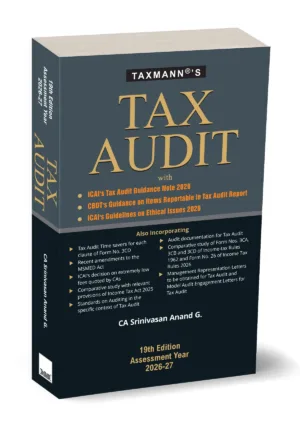


Taxmann Tax Audit By Srinivasan Anand G 19th Edition August 2026
Original price was: ₹1,395.₹976Current price is: ₹976.
Tax Audit rests on a simple premise: a tax audit is a procedure, not a subject. Its 73 chapters follow the assignment in the order it actually runs—from whether an audit is required, through eligibility and the Standards on Auditing, into a dedicated chapter for every clause of Form No. 3CD, and out through signing, e-filing, UDIN, liabilities and revision. Four authorities bear on each clause at once: ICAI’s 2026 Guidance Note, CBDT’s Departmental Guidance reproduced clause-wise, the new ethical and ceiling Guidelines, and the Income Tax Act 2025—which culminates in a chapter on the merged Form No. 26. The signature device is the Time Saver: in 45 of the 48 clause chapters, a block that tells the auditor what need not be done. Leaner than its predecessors and backed throughout by model letters, clause-wise representations and documentation checklists, it is written to be carried to the client’s premises, not left on the shelf.
Tax Audit By Srinivasan Anand G 19th Edition August 2026
Tax Audit By Srinivasan Anand G 19th Edition August 2026
Description
Tax Audit is the definitive practitioner’s manual on the audit of accounts under Section 44AB—a book written from the tax auditor’s chair rather than the commentator’s desk. Published since 2004 and now in its 19th Edition, it has earned its place on the profession’s desk by answering the questions that actually arise during the audit season: what has to be reported in each clause, what may safely be skipped, where the statutory audit report can be relied upon, what to write in the observations column, and what must be on the file if the report is ever questioned.
The book’s organising idea is that a tax audit is a procedure, not a subject. So it is built as a workflow; running from whether the audit is required at all, through eligibility to accept it and the Standards that govern its conduct, into a dedicated chapter for every single clause of Form No. 3CD, and out through signing, e-filing, UDIN generation, liabilities and revision. Each clause chapter is a self-contained work programme.
What sets this Edition apart is that four separate authorities are brought to bear on every clause at once. ICAI’s 2026 Tax Audit Guidance Note is cited over 170 times, usually to the specific paragraph. CBDT’s Departmental Guidance, ‘Items Reportable in the Tax Audit Report’, is reproduced clause-wise under its own heading, so the auditor can reconcile the professional view with the Department’s stated expectation before signing. ICAI’s Guidelines on Ethical Issues 2026 and the new Chartered Accountants (Limit on Number of Tax Audits) Guidelines 2025 govern the acceptance chapters. The Income Tax Act 2025 and the Income Tax Rules 2026 run alongside as a comparative thread, culminating in a dedicated chapter on the merged Form No. 26, which will replace Forms 3CA, 3CB and 3CD from the following year.
The author has also re-engineered the book itself. This Edition is ‘a smarter version of the book with far fewer pages, making it easier to handle and more portable.’ Nothing has been dropped; the bulk has been converted—discursive commentary replaced by Time Savers, planning tips, must-do and must-not-do lists, cross-clause reconciliations and clause-wise documentation checklists. It is meant to be carried to the client’s premises, not left on the shelf.
The Present Publication is the 19th Edition | Assessment Year 2026-27, amended upto 13th August 2026. This book is authored by CA. Srinivasan Anand G., with the following noteworthy features:
- [Tax Audit Time Savers for Each Clause of Form No. 3CD] The signature device of this Edition, and the reason it reads differently from every other book on the subject. Forty-five of the forty-eight clause chapters open with a Time Saver block that tells the auditor what he need not do—which clauses to skip outright for a given class of assessee, where the e-filing utility auto-populates or auto-closes a field, where reliance on the statutory audit report is legitimate and what must then be disclosed, and where a single Yes/No selection disposes of the clause. The device has an honest counterpart: where a shortcut would be wrong, the book says so in the same voice —’Reporting one consolidated amount is not a ‘tax audit time-saver’ but a violation of requirements of Clause 30′
- [Tax Audit Planning Tips and Cross-clause Linkages] Alongside the Time Savers, the clause chapters carry planning material showing how a single transaction surfaces in several clauses at once, and—more usefully—the order in which clauses should be taken up, so that dependent clauses are not filled before the ones they draw on. This is the feature that guards against the internally inconsistent report, which is the most avoidable exposure a tax auditor carries
- [The Standards on Auditing, Rewritten for Tax Audit] The SAs are covered ‘in a lucid manner as a ‘must do’ list of things for the auditor, a ‘must not do’ list of things and a ‘not expected to do’ list of things.’ They are not restated as general auditing theory; every requirement is translated into something the tax auditor must do, must not do, or is not expected to do. A separate chapter then does what few books attempt—it distinguishes the audit of the financial statements from the assurance engagement on the Form 3CD particulars, and identifies which Standards actually bear on the latter
- [Model Engagement Letters and Management Representation Letters] Two complete, ready-to-adapt Audit Engagement Letters—one for an entity already subject to statutory audit, one for an entity that is not—each running to sixteen numbered clauses covering scope, respective responsibilities, working papers, confidentiality, independence, limitation of damages, indemnity, fees, governing law and termination, with fill-in placeholders and an acknowledgement block. A further chapter supplies fifty-two clause-wise written representations and MRLs with draft wording and blank tabular formats
- [Audit Documentation, Clause by Clause] A dedicated chapter of fifty clause-wise working-paper checklists, deliberately mirroring the MRL chapter so that the representation and the file entry can be built together. It rests on a proposition the author states without hedging—’It is said that work not documented is work not done’—and on the standard that the audit file ‘should be capable of speaking for itself’
- [Written Against the Live E-Filing Utility] With more than 175 references to the utility, the book describes reporting as it must actually be executed on the portal rather than as the notified form reads. It reproduces the utility’s own dropdown menus—including the seventeen qualification types offered for Form 3CA and the sixteen for Form 3CB, which the author repurposes as a verification checklist—flags the thousand-character ceiling on each observation, notes where the utility diverges from the notified form, and identifies the places where it will not validate an entry the auditor might assume is being checked
- [A Book that Argues] Where the author believes the Guidance Note or a Technical Guide is wrong, he says so and gives reasons, setting out the competing views and the basis for preferring one. Readers get the majority position, the dissent, and enough to form and record their own view
The coverage of the book is as follows:
- Getting to the Assignment
- Financial Statements of Non-corporate Entities
- The Standards on Auditing
- The Reports Themselves
- Clause-by-clause Commentary
- The Transition to the New Regime
- The Practitioner’s Toolkit
The structure of the book is as follows:
- Sequenced as the Assignment Runs — The seventy-three chapters follow the order of the auditor’s own questions:
- Is a tax audit required at all?
- Am I eligible to accept it?
- What formalities must I complete before accepting?
- Which Standards on Auditing bind me?
- What do I report in each clause of Form No. 3CD?
- What representations and working papers must I hold on file?
- How do I sign, file and generate the UDIN?
- What changes next year?
- The Architecture of a Clause Chapter — Across the forty-eight clause chapters, the commentary is built on a consistent structure:
- Important AuditPpoints—the numbered checklist that carries the chapter; opens forty-seven of the forty-eight
- Tax Audit Time-Savers—what may be skipped, relied upon, or disposed of with a single selection in the utility; follows in forty-five of them
- Required—precisely what must be reported, and what must not; in roughly two-thirds of the chapters
- Audit Procedures—the verification steps to be performed and the evidence to be examined
- Cross-clause Linkages—where the same transaction surfaces elsewhere in the form, and the order in which clauses should be taken up
- Departmental Guidance for Filling up the Clause—CBDT’s own stated expectation, for the clauses it has addressed
- Changes Made Under the New Act—the corresponding provision and what it alters; in around eighteen chapters
- Two points about how that structure behaves in practice:
- Sections beyond the first two are added as the clause requires, rather than by rote—a one-page clause is not padded out to match a difficult one
- Most of the substance sits in numbered audit points with run-in sub-headings inside those sections, which is what allows a single sub-clause to be worked through in eighty-five discrete, individually citable points
- Presentation Devices Used Throughout
- Comparative and applicability tables
- Decision matrices
- Flowcharts
- Worked numerical examples
- FAQ-style headings set into the running text
- Specimen drafts and model letters
- Case-law digests grouped by fact pattern
- Reproductions of the e-filing utility’s own screens and dropdown menus
- Footnotes carrying the author’s dissents from received positions
About the Author
Srinivasan Anand G is a distinguished chartered accountant with extensive accounting, auditing, and corporate law expertise. He holds qualifications from all three premier professional institutes in India—the Institute of Chartered Accountants of India (ICAI), the Institute of Cost Accountants of India (ICWAI), and the Institute of Company Secretaries of India (ICSI).
| Weight | 0.63 kg |
|---|---|
| Book Author | Srinivasan Anand G |
| Binding | Paperback |
| Edition | 19th Edition August 2026 |
| HSN | 49011010 |
| ISBN | 9789375614968 |
| Language | English |
| Publisher | Taxmann |
Only logged in customers who have purchased this product may leave a review.
Related products
 Taxmann Tax Audit By Srinivasa...
 Original price was: ₹1,395.₹976Current price is: ₹976.
Reviews
There are no reviews yet.