
No products in the cart.
Return To Shop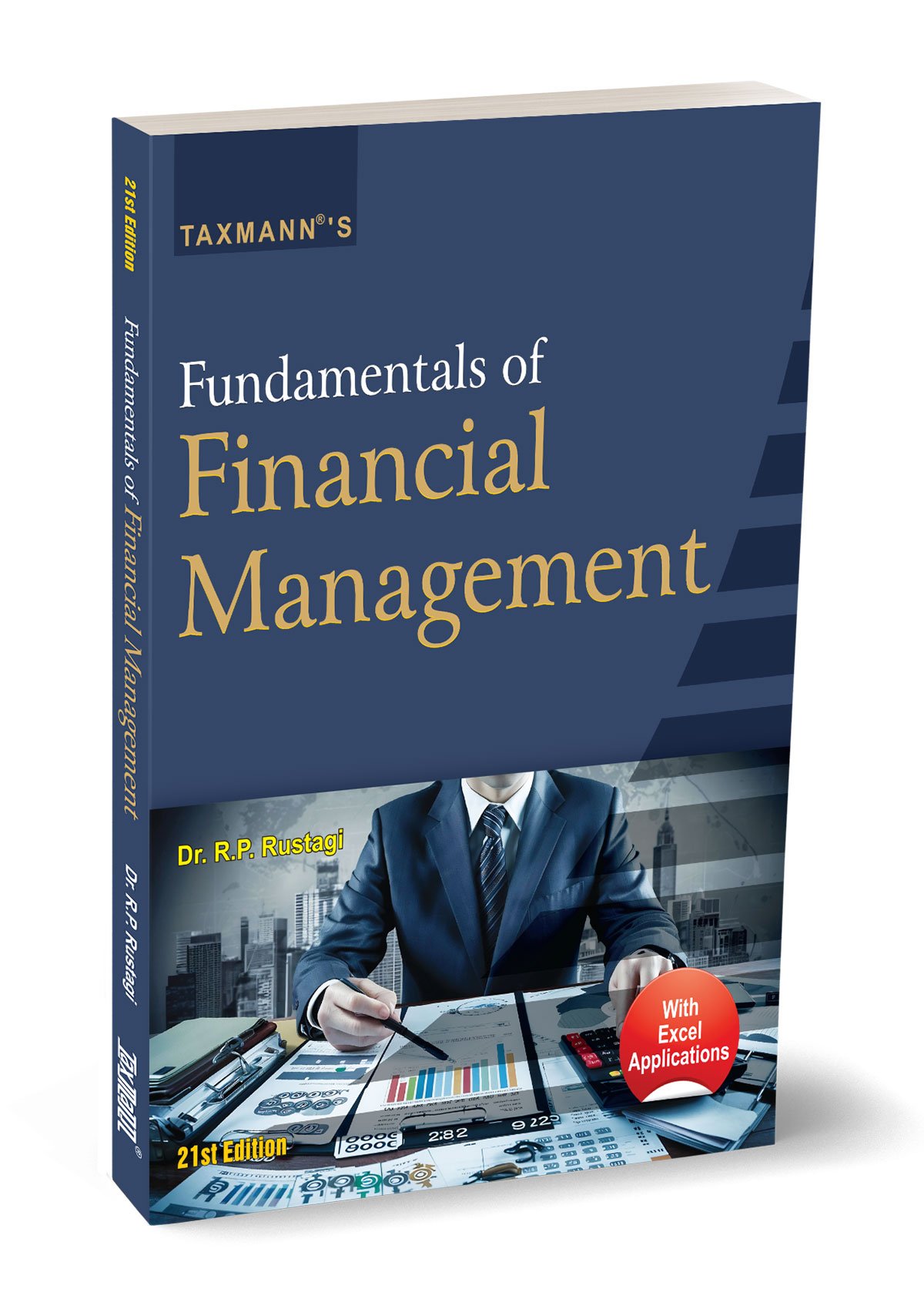
Taxmann Fundamental of Financial Management for B.Com.(HONS) By R.P Rustagi Edition 2026
Original price was: ₹725.₹543Current price is: ₹543.
Fundamentals of Financial Management with Excel Applications is a comprehensive undergraduate textbook covering the full spectrum of financial decision-making—Investment, Financing, and Dividend Decisions—built around the objective of shareholder wealth maximisation. Now in its 21st Edition, the book progresses systematically across Capital Budgeting, Cost of Capital, Leverage, Capital Structure Theories, Dividend Policy, Working Capital Management, and Valuation of Securities, with every chapter structured around graded illustrations with working notes, MCQs, and unsolved problems for examination preparation. New to this Edition are dedicated sections on Risk Analysis in Capital Budgeting and MIRR, an Excel appendix translating core calculations into spreadsheet models, and Delhi University examination papers up to December 2025 with suggested answers. Shaped by over four decades of classroom teaching at Shri Ram College of Commerce, University of Delhi, the book is tailored for B.Com. (Hons.) III Semester students but equally relevant for CA, CS, ICWA, MBA, M.Com., CFA, and PGDM courses.
Fundamental of Financial Management for B.Com.(HONS) Edition 2026
Fundamental of Financial Management for B.Com.(HONS) Edition 2026
Description
Fundamentals of Financial Management with Excel Applications is a comprehensive undergraduate textbook that covers both the theory and practice of financial decision-making. The book is built around a single unifying premise—that every financial decision must be evaluated in terms of its contribution to the maximisation of shareholder wealth—and develops this across all three domains of the finance manager’s mandate: the Investment Decision, the Financing Decision, and the Dividend Decision.
Now in its 21st Edition, the book has been shaped by over four decades of the author’s classroom teaching at Shri Ram College of Commerce, University of Delhi, and refined through consistent feedback from successive student batches. The result is a text that is analytically rigorous but deliberately non-intimidating in language and presentation—where abstract theory is always grounded in worked numerical illustrations, and every concept connects back to the practical reality of how a finance manager actually thinks and decides.
This book is intended for the following audience:
- B.Com. (Hons.) III Semester students, University of Delhi—the syllabus is reproduced in full and mapped chapter by chapter
- Students of Other Central & Affiliated Universities Across India following equivalent financial management courses
- Students of CA (Foundation/IPCC), CS, ICWA, MBA, M.Com., CFA, and PGDM Courses—the author is a visiting faculty member for ICAI and ICSI executive development programmes, and the text has been used at both the undergraduate and the post-graduate professional level
The Present Publication is the 21st Edition, authored by Dr R.P. Rustagi, with the following noteworthy features:
- [Consistent Eight-Part Chapter Architecture] Every chapter follows the same internal structure without exception:
- Synopsis (Chapter Plan) → Main Body → Points to Remember → Graded Illustrations (solved) → Objective Type Questions (True/False) → Multiple Choice Questions → Theoretical Assignments → Unsolved Problems with Answers
- This uniformity enables students to navigate the book predictably and use it systematically for examination preparation
- [Graded Illustrations with Working Notes] The distinguishing feature of the book is its volume and quality of solved problems. Illustrations are sequenced by complexity and accompanied by step-by-step working notes that explain not just the computation but the underlying logic—including treatment of taxes, depreciation, incremental cash flows, and salvage values in capital budgeting problems; selection of weights in WACC; arbitrage mechanics in MM models; and operating cycle calculations in working capital
- [Depth of MCQ and Objective Question Banks] The 21st Edition adds MCQs at the end of all major chapters, with answer keys. These span conceptual understanding and numerical application and are directly calibrated to Delhi University’s examination pattern
- [Past Examination Papers with Suggested Answers] Appendix II reproduces complete question papers from four recent Delhi University B.Com. (Hons.) examinations—November 2022 (Semester V), December 2023 (Semester IV), December 2024 (Semester III), and December 2025 (Semester III)—together with detailed suggested answers to all practical questions. This gives students direct benchmarking against actual graded expectations
- [Excel Applications Appendix]
- Appendix I provides a systematic translation of the book’s core financial calculations into Microsoft Excel, using built-in functions including PV, FV, NPV, IRR, MIRR, XIRR, XNPV, and others
- Each application is shown in full cell-level table format—both the formula structure (modelling) and the output—covering Time Value of Money (single sums, annuities, perpetuities, unequal cash flows, loan repayment schedules), Capital Budgeting (Payback Period, NPV, IRR, PI, MIRR, non-periodic cash flows), Cost of Capital (WACC computation including marginal cost scenarios), and Leverage Analysis (operating, financial, and combined leverages across multi-firm comparisons)
- Manual and Excel solutions are placed alongside each other so students can cross-verify
- [New in the 21st Edition]
- Risk Analysis in Capital Budgeting: new section covering Certainty Equivalent and Risk-Adjusted Discount Rate methods
- Modified Internal Rate of Return (MIRR): new dedicated coverage in Chapter 4
- Summary of Cash Flow Estimation Principles added to Chapter 4 as a quick-reference framework
- New practical questions added across Graded Illustrations in multiple chapters
- Additional working notes and explanatory comments inserted throughout
- Latest Delhi University examination papers (up to December 2025) incorporated with solutions
The coverage of the book is as follows:
- Part I — Background
- Part II — Long-Term Investment Decisions: Capital Budgeting
- Part III — Financing Decision
- Part IV — Dividend Decision
- Part V — Management of Current Assets
- Part VI — Valuation of Securities
The 17 chapters are organised across six thematic parts, each aligned to a major area of financial decision-making:
- Part I | Background | Chapters 1–2 — Introduction, Time Value of Money
- Part II | Long-Term Investment Decisions | Chapters 3–4 — Capital Budgeting
- Part III | Financing Decision | Chapters 5–9 — Cost of Capital, Leverage, EBIT-EPS, Capital Structure Theories
- Part IV | Dividend Decision | Chapters 10–11 — Dividend Models, Policy Determinants
- Part V | Management of Current Assets — Chapters 12–16 | Working Capital, Cash, Receivables, Inventory
- Part VI | Valuation | Chapter 17 — Valuation of Bonds, Preference Shares, Equity]
- Three appendices follow:
- Appendix I — Financial Decision Making with Excel
- Appendix II — Past Year Delhi University Question Papers with Suggested Answers
- Appendix III — Mathematical Tables
About the Author
Dr. R.P. Rustagi is Associate Professor, Department of Commerce, Shri Ram College of Commerce, University of Delhi. He is M.Com., M.Phil. (Accounting and Finance) from Delhi School of Economics, University of Delhi, besides being a Fellow Member of the Institute of Company Secretaries of India, New Delhi. He obtained Doctorate from Jiwaji University, Gwalior. He has been teaching Accounting and Finance at Shri Ram College of Commerce (his alma mater) for more than three decades. He is also associated with Post-graduate teaching in Department of Commerce, University of Delhi. He is a visiting faculty in Executive Development Programmes in Finance arranged by the ICAI, ICSI and other Management Institutes. As an academician, his areas of interest are Strategic Financial Management, Investment Management, Capital Market, etc. He is an established author in Accounting and Financial Management.
| Weight | 0.73 kg |
|---|---|
| Book Author | R P Rustagi |
| Binding | Paperback |
| Edition | 21st Edition 2026 |
| ISBN | 9789375613756 |
| HSN | 49011010 |
| Language | English |
| Publisher | Taxmann |
Only logged in customers who have purchased this product may leave a review.
Related products


 Taxmann Fundamental of Financi...
Reviews
There are no reviews yet.