
No products in the cart.
Return To Shop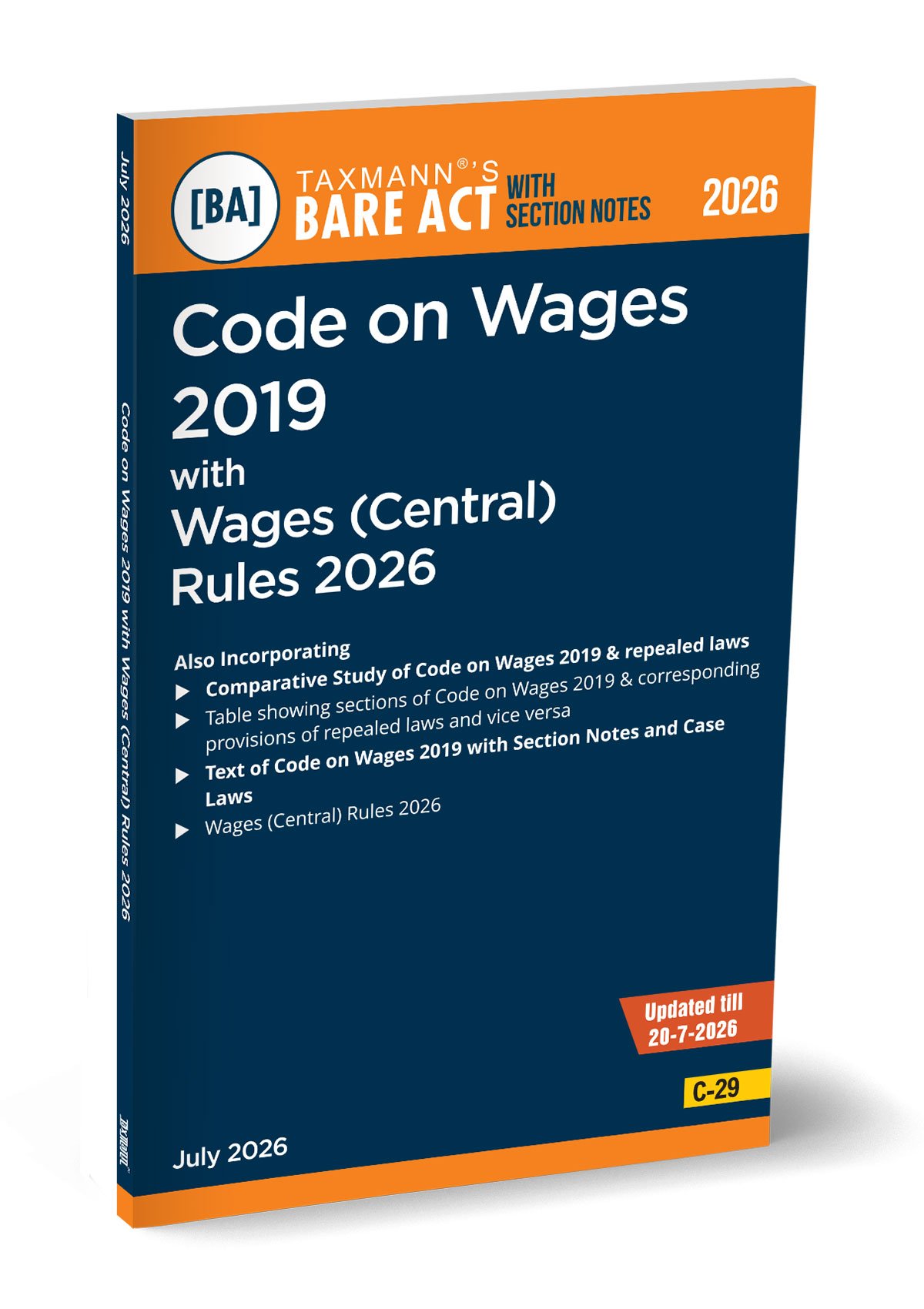
Taxmann Code on Wages 2019 with Code on Wages Rules 2026 Bare Act Edition July 2026
Original price was: ₹215.₹150Current price is: ₹150.
Code on Wages 2019 with Wages (Central) Rules 2026 [Bare Act with Section Notes] by Taxmann presents India’s wage law in its fully enforced, post-Code form (w.e.f. 21-11-2025 vide S.O. 5322(E)), consolidating the Payment of Wages Act 1936, Minimum Wages Act 1948, Payment of Bonus Act 1965, and Equal Remuneration Act 1976 into a single framework. The defining feature is provision-by-provision Section Notes with relevant Case Laws beneath each section, mapped to the corresponding clauses of the repealed Acts—turning the Bare Act into a self-contained transition tool. This July 2026 Edition completes the statutory ecosystem with the finally notified Code on Wages (Central) Rules 2026 (G.S.R. 343(E), dated 8-5-2026)—54 Rules across 8 Chapters with Forms I to IX and Appendices A to D, superseding 17 sets of legacy rules, and carrying the Corrigendum of 15-7-2026 that corrected the short title of the Rules—together with a front-placed Comparative Study, five-way cross-reference Tables, Subject Index, Statement of Objects and Reasons, Notes on Clauses, and an Appendix of ten referenced Acts. Division Three rounds it off with the complete notification record (including the ₹18,000 supervisory wage-ceiling notification of 30-1-2026 and the 12-5-2026 series designating authorities under sections 4, 7, 31, 39, 45, 49, 51, 53 and 56), FAQs on all four Labour Codes with Additional FAQs as on 16-3-2026, and a Compliance Handbook for Employers spanning all four Codes—delivering a complete, single-volume operational reference for the post-enforcement phase. Law stated as amended till 20-7-2026.
Code on Wages 2019 with Code on Wages Rules 2026 Bare Act Edition 2026
Code on Wages 2019 with Code on Wages Rules 2026 Bare Act Edition 2026
Descriptions : –
Code on Wages 2019 with Wages (Central) Rules 2026 [Bare Act with Section Notes] by Taxmann is a fully consolidated, application-ready statutory publication presenting India’s wage law in its complete, post-enforcement form. The Code on Wages—brought into force with effect from 21st November 2025 vide Notification S.O. 5322(E)—subsumes and replaces four foundational wage statutes, namely the Payment of Wages Act 1936, the Minimum Wages Act 1948, the Payment of Bonus Act 1965, and the Equal Remuneration Act 1976, reconstituting them into a single legislative architecture governing minimum wages, floor wage, payment of wages, deductions, bonus, advisory boards, claims, inspection, and offences. The publication’s core editorial feature is Section Notes—brief, provision-by-provision indications placed immediately after each statutory section—together with relevant Case Laws reproduced beneath the section, cross-referencing the corresponding clauses of the four repealed Acts and the related Rules and decisions that bear on interpretation.
This July 2026 Edition is the first to carry the finally notified Code on Wages (Central) Rules 2026 (G.S.R. 343(E), dated 8-5-2026)—54 Rules across 8 Chapters, with Forms I to IX and Appendices A to D, notified in supersession of 17 sets of erstwhile rules—and a substantially expanded Division Three carrying the complete notification, clarification and compliance record. It is also the first edition to carry Corrigendum G.S.R. 629(E) of 15-7-2026, which corrected the short title of the Rules. The volume is completed by a front-placed Comparative Study, five sectional cross-reference Tables (Code v repealed laws and the reverse), a Subject Index, the Statement of Objects and Reasons, Notes on Clauses, an Appendix reproducing provisions of ten other Acts referred to in the Code, the enforcement and clarificatory notifications, seven sets of FAQs covering all four Labour Codes, and a practitioner-oriented Compliance Handbook for Employers—making it a complete, single-volume operational reference for understanding, applying, and complying with India’s wage law in its post-enforcement phase.
This publication is intended for users who apply, interpret, administer, adjudicate, or transition into the Code on Wages regime, including:
- HR, Payroll, and Compliance Heads responsible for wage administration, bonus disbursement, statutory deductions, and wage-slip and register compliance
- Labour & Employment Law Practitioners advising on minimum wages, bonus eligibility, equal remuneration, deductions, and claims under the Code
- Employers, Industrial Establishments, and Management Representatives assessing the revised wages definition, the 50% cap on deductions, the floor wage framework, and the universal applicability of the Code
- In-house Counsel, Company Secretaries, and Finance Controllers responsible for Code-readiness, statutory disclosures, and audit of wage-related accounts
- Inspectors-cum-Facilitators, Appellate Authorities, and Adjudicatory Officers applying the consolidated claims, appeal, and offences architecture, and now identifiable from the notified jurisdiction tables reproduced in Division Three
- Trade Unions, Worker Representatives, and Employee-Side Advisers interpreting wage rights, gender-equality provisions, and the bonus regime
- Law Students, Academicians, and Policy Researchers studying India’s transition from legacy wage statutes to the Code-based framework
The Present Publication is the July 2026 Edition, with the law stated as amended till 20th July 2026. It covers the amended and updated text of the Code on Wages [Act No. 29 of 2019] and the Code on Wages (Central) Rules 2026, with the following noteworthy features:
- [Section Notes – Core USP] Brief, plain-language annotations set immediately beneath the statutory provisions they explain—never in a separate commentary volume—identifying the corresponding clauses of the four repealed Acts and highlighting consolidated, modified, or newly introduced material. The fuller notes open with a “Provisions of section … in a nutshell” summary and then unpack the provision point by point, turning the Bare Act into a self-contained transition tool
- [Case Laws Beneath the Provision] Relevant judicial precedents reproduced directly beneath the provisions they bear upon—including decisions rendered under the repealed Acts that continue to govern interpretation of the Code, such as Manganese Ore v. Chandi Lal (1990) 77 FJR 420 (SC) on the payment of wages in kind—so precedent can be verified without leaving the page
- [Chapter-Level Introduction to Payment of Wages] Chapter III is preceded by a dedicated Introduction that lists the sections it contains, explains the scheme of the Chapter, and flags how it departs from the Payment of Wages Act—notably the extension of timely payment of wages to all employees irrespective of sector and without any wage ceiling, and the carve-out for Government establishments under section 25
- [Enforcement Footnotes Throughout] Some 50 footnotes recording the date from which the provisions have been brought into force, together with the enabling notification, so the reader is never in doubt about what is operative today
- [Five-Way Statutory Cross-Reference Tables] Tables showing the sections of the Code on Wages 2019 alongside the corresponding provisions of each repealed Act—Payment of Bonus Act 1965; Minimum Wages Act 1948; Payment of Wages Act 1936; and Equal Remuneration Act 1976—together with four reverse-direction tables mapping each repealed Act to the corresponding sections of the Code, enabling readers to locate provisions in either direction without consulting separate sources
- [Front-Placed Comparative Study] A detailed subject-wise and section-wise comparison between the Code on Wages 2019 and the four repealed Acts, identifying retained provisions, substantive departures, rationalised thresholds (universal applicability, reduction of the cap on deductions from 75% to 50%, abolition of the working-day stipulation) and consciously omitted concepts (LIC premium deductions, Post Office insurance deductions, Fidelity Guarantee Bond deductions)
- [Code on Wages (Central) Rules 2026 – Final Notified Text] The complete operative procedural framework as notified vide G.S.R. 343(E), dated 8-5-2026—54 Rules across 8 Chapters, notified in supersession of 17 sets of erstwhile rules (from the Payment of Wages (Procedure) Rules 1937 to the Code on Wages (Central Advisory Board) Rules 2021 and the Ease of Compliance to Maintain Register Rules)—covering the manner of calculating the minimum rate of wages, interval for revision of variable dearness allowance, fixation of floor wage, working hours, weekly rest and night shifts, recovery procedures, computation of gross profits for banking and other companies, carry-forward of allocable surplus, Central Advisory Board procedure, and undisbursed dues
- [Forms I to IX and Appendices A to D Reproduced in Full] Employee Register; single application under section 45(5); appeal under section 49(1); Register of Wages, Overtime, Advances, Fines and Deductions for Damage and Loss; Wage Slip; application for composition of offence under section 56(4); Nomination Form; forms of notice to the respondent; and the Attendance Register-cum-Muster Roll—followed by the four working schedules that do the heavy lifting on bonus: Appendix A, a ten-year worked illustration of set on and set off of allocable surplus [rules 22, 23, 27 and 28]; Appendix B, computation of gross profits for a banking company [rule 24]; Appendix C, computation of gross profits for employers other than banking companies [rule 25]; and Appendix D, deduction of further sums by category of employer [rule 26]
- [Complete Notification Record – Updated till 20-7-2026] Fifteen notifications across twelve section-wise entries, comprising the partial-enforcement notification of 18-12-2020 [S.O. 4604(E)]; the principal enforcement notification of 21-11-2025 [S.O. 5322(E)] bringing sections 1 to 41, 42(4) to (9), 43 to 66, 67(1), 67(2)(a) to (r) and (u) to (zc), 67(3) to (5), 68 and 69 into force; the ₹18,000 supervisory wage-ceiling notification of 30-1-2026 [S.O. 454(E)] under section 2(z)(d); the 12-5-2026 series [S.O. 2450(E) to S.O. 2458(E)] notifying the officers, authorities and territorial jurisdictions for sections 4, 7, 31, 39, 45, 49, 51, 53 and 56; and the earlier notifications they supersede, reproduced for continuity (S.O. 2765(E) of 28-8-1965, S.O. 2571(E) of 30-9-2014 and S.O. 3730(E) of 17-10-2019)
- [Corrigendum G.S.R. 629(E), dated 15-7-2026 – Captured] The most recent development in the volume. The Rules as first notified on 8-5-2026 were titled the Code on Wages (Central) Rules, 2026; Corrigendum G.S.R. 629(E) of 15-7-2026 substituted the short title so that rule 1(1) now reads the Wages (Central) Rules, 2026. This edition is the first to carry the correction, footnoted at the very rule it affects—five days before the 20-7-2026 cut-off
- [Seven Sets of FAQs Spanning All Four Labour Codes] Official clarifications organised Code-wise—on the Code on Wages 2019, the Industrial Relations Code 2020, the Occupational Safety, Health and Working Conditions Code 2020 (two separate sets) and the Code on Social Security 2020—together with general FAQs on the Labour Codes and Additional FAQs as on 16-3-2026, which settle live practical questions such as whether overtime forms part of the 50 per cent wage calculation (it does) and which statutory components count towards “total remuneration” for applying the wage floor
- [Compliance Handbook for Employers under the Four Labour Codes] The Government’s employer-facing handbook (Central Government Sphere) reproduced in full—seven Chapters and five Annexures
- [Summary of Action Points for Employers] Chapter 7 of the Handbook is a ready compliance matrix—a quick snapshot of what must be done on day one, every month, every year, and when particular events occur—sorted into Foundational, Monthly, Periodical/Annual and Event-Based compliance, from registration and licensing through wage slips and the Unified Annual Return to accident reporting within 24–72 hours and settlement of final dues (wages within 2 days; gratuity within 30 days)
- [Annexures 1 to 5 to the Handbook] Key Definitions under the Code on Wages 2019 (including the 50 per cent rule on “other allowances” worked through clause by clause); Key Definitions under the Industrial Relations Code 2020; the Third Schedule to the Industrial Relations Code 2020; the Third Schedule to the OSH & Working Conditions Code 2020; and the First Schedule to the Code on Social Security 2020 setting out chapter-wise applicability thresholds
- [Statement of Objects and Reasons & Notes on Clauses] Reproduced in full to support purposive interpretation and legislative-intent arguments
- [Appendix of External Provisions] Reproduces the relevant text of ten other Central Acts referenced in the Code (Apprentices Act 1961, Code of Criminal Procedure 1973, Companies Act 2013, Factories Act 1948, General Clauses Act 1897, Income-tax Act 1961, Industrial Disputes Act 1947, Merchant Shipping Act 1958, Sales Promotion Employees (Conditions of Service) Act 1976, and the Working Journalists and Other Newspaper Employees (Conditions of Service) and Miscellaneous Provisions Act 1955), eliminating the need to consult separate volumes. Section 6 of the General Clauses Act is reproduced because section 69(3) of the Code expressly applies it to the repeal of the four wage statutes—the provision that governs what survives the repeal
- [Subject Index] Detailed alphabetical index for rapid topical retrieval
The publication opens with the transition apparatus and is then organised across three Divisions, sequencing context → primary law → subordinate legislation → operational compliance:
- Transition Tables & Comparative Study
- Table showing sections of the Code on Wages 2019 and the corresponding provisions of the Repealed Laws
- Table showing sections of the Equal Remuneration Act 1976 and the corresponding provisions of the Code
- Table showing sections of the Minimum Wages Act 1948 and the corresponding provisions of the Code
- Table showing sections of the Payment of Bonus Act 1965 and the corresponding provisions of the Code
- Table showing sections of the Payment of Wages Act 1936 and the corresponding provisions of the Code
- Comparative Study of the Code on Wages 2019 versus the Equal Remuneration Act 1976/Minimum Wages Act 1948/Payment of Wages Act 1936/Payment of Bonus Act 1965
- Division One | Code on Wages 2019
- Arrangement of Sections
- Text of the Code on Wages 2019—all 69 sections across 9 Chapters—with Section Notes, Corresponding Provisions, Case Laws, enforcement footnotes, and an Introduction to Chapter III
- Subject Index
- Statement of Objects and Reasons
- Notes on Clauses
- Appendix – Provisions of Other Acts Referred to in the Code on Wages 2019
- Division Two | Rules
- Arrangement of Rules
- Code on Wages (Central) Rules 2026—Chapters I to VIII, Rules 1 to 54, with the Corrigendum of 15-7-2026 footnoted at rule 1(1)
- Forms I to IX (Employee Register, Register of Wages, Wage Slip, Nomination Form, Attendance Register-cum-Muster Roll, and connected formats)
- Appendices A to D—set on and set off of allocable surplus; computation of gross profits for banking companies and for other employers; and deduction of further sums by category of employer
- Division Three | Notifications and Clarifications
- Notifications—fifteen in all, arranged section-wise across twelve entries, covering partial enforcement, principal enforcement, the supervisory wage-ceiling notification, the 12-5-2026 series notifying authorities and jurisdictions under sections 4, 7, 31, 39, 45, 49, 51, 53 and 56, and the superseded notifications reproduced for continuity
- FAQs—seven sets, on the Code on Wages 2019, the Industrial Relations Code 2020, the OSH & Working Conditions Code 2020 (two sets) and the Code on Social Security 2020, plus general and Additional FAQs (as on 16-3-2026)
- Compliance Handbook for Employers under the Four Labour Codes (Central Government Sphere)—Chapters 1 to 7, closing with the Summary of Action Points for Employers
- Annexures 1 to 5—Key Definitions under the Wages and Industrial Relations Codes, the Third Schedules to the IR and OSH & WC Codes, and the First Schedule to the Code on Social Security
- Transition Tables & Comparative Study
Taxmann’s Editorial Board
Taxmann’s Research & Editorial Board includes Chartered Accountants, Company Secretaries, and Lawyers working under the editorial direction of Editor-In-Chief Mr Rakesh Bhargava. The team operates at the junction of legal expertise and editorial rigour, producing content that meets the high standards of India’s professional knowledge community. All content is sourced solely from authorised statutory repositories and is continuously updated to reflect the latest judicial pronouncements and legislative changes. Analysis is based on primary references—sections, rules, circulars, notifications, and rulings—ensuring that every insight is traceable, defensible, and practice-ready.
| Weight | 0.3 kg |
|---|---|
| Binding | Paper back |
| HSN | 49011010 |
| Edition | July Edition 2026 |
| ISBN | 9789375614876 |
| Language | English |
| Publisher | Taxmann |
Only logged in customers who have purchased this product may leave a review.
Related products
 Taxmann Code on Wages 2019 wit...
 Original price was: ₹215.₹150Current price is: ₹150.
Reviews
There are no reviews yet.