
No products in the cart.
Return To Shop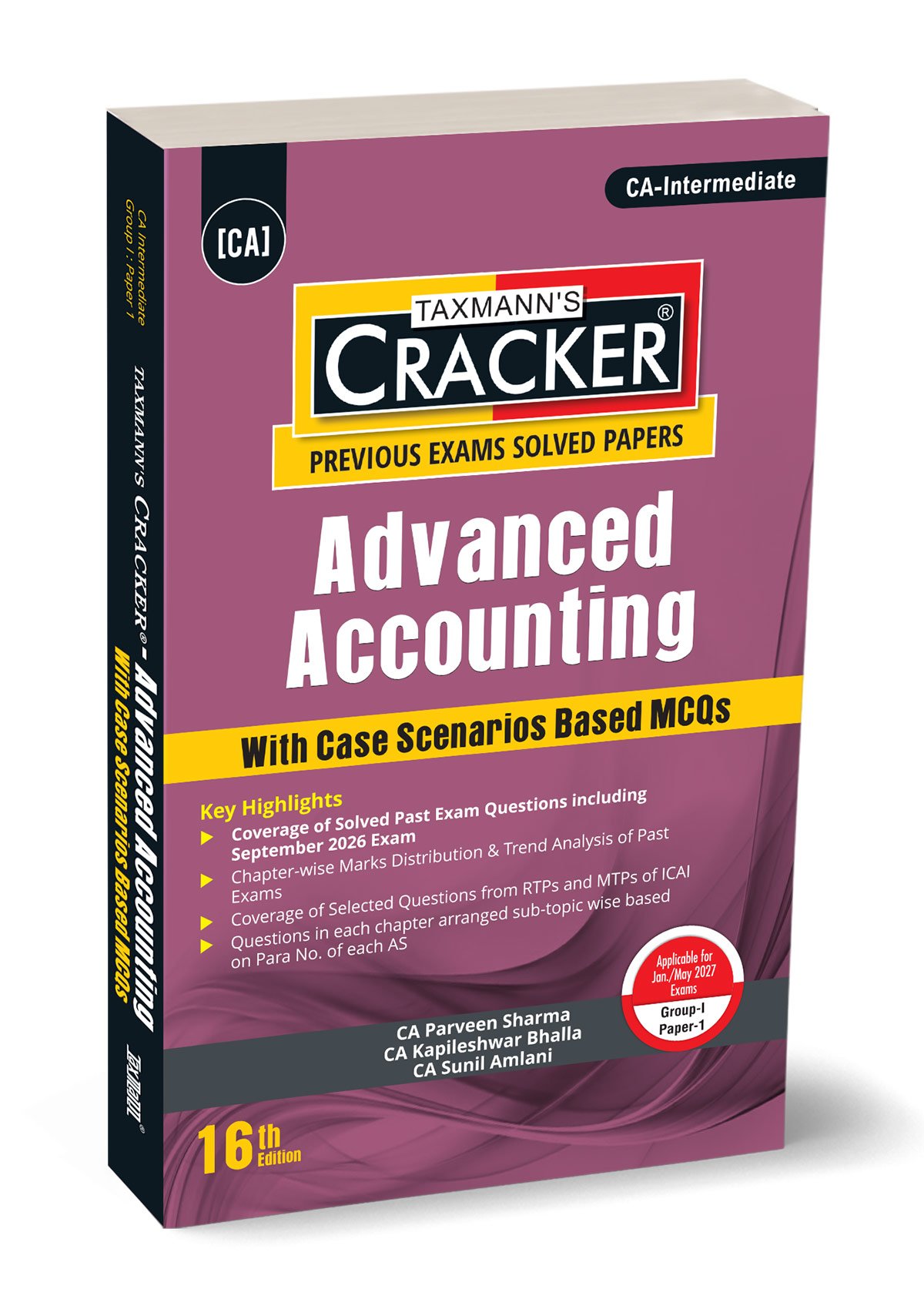
Taxmann CA Inter Advanced Accounts CRACKER by CA Parveen Sharma ,CA Kapileshwar Bhalla & CA Sunil Amlani 16th Edition Jan & May 27
Original price was: ₹945.₹756Current price is: ₹756.
Advanced Accounting | CRACKER is a question bank with full answers: more than 600 questions across sixteen chapters for CA Intermediate Group I, Paper 1, each printed in a grey box with its answer directly below. Questions are grouped by topic rather than by exam year, and in the Accounting Standards chapters the headings name the paragraphs being applied, so a standard is worked through in the order the standard itself is written. Theory answers open with what the standard says and close with an “Analysis and Conclusion” applied to the facts; practical answers carry the full working, from computation statements and journal entries to Schedule III balance sheets, cash flow statements by both methods, and consolidated accounts. Every question carries a tag naming each exam session, RTP and MTP it has appeared in, with repeats flagged where the wording later changed. The book closes with a separate chapter of fifteen case scenarios and seventy-five MCQs, and the May 2026 and September 2026 papers solved in full.
CA Inter Advanced Accounts CRACKER Parveen Sharma Jan & May 27
CA Inter Advanced Accounts CRACKER Parveen Sharma Jan & May 27
Description
Advanced Accounting | CRACKER is a question bank with full answers. It carries more than 600 questions across sixteen chapters. Each question sits in a grey box. The answer comes straight after it.
The answers are written out in full. Theory answers follow the same shape every time. They start by stating what the standard says, often quoting the exact paragraph. They end under a heading called “Analysis and Conclusion”, where the rule is applied to the facts in the question.
Practical answers show the full working, not just the final figure. Every computation statement, working note and journal entry is printed. So are the complete formats: Schedule III balance sheets, statements of profit and loss, notes to accounts, cash flow statements by both methods, realisation accounts, capital reduction accounts, branch stock and branch adjustment accounts, and consolidated balance sheets. Each one is drawn out line by line.
Three things shape how the questions are arranged.
- First, questions are not listed one after another. They are grouped under grey heading bands, and each band names the topic being tested. In the Accounting Standards chapters most of these bands also give the paragraph numbers of the standard, so you work through a standard in the order the standard itself is written
- Second, the practical chapters use a difficulty ladder instead. They start with basic problems and move up to advanced ones, step by step
- Third, the consolidation chapter uses one fixed method for every problem: Analysis of Profit, then Minority Interest, then Cost of Control, then Special Issues, and only then the consolidated balance sheet and its notes
Every question also shows where it came from. A tag in italics sits under each one, naming the exam sessions it has appeared in and any ICAI Revision Test Paper or Mock Test Paper that carried it. Many tags name several sources, and some add the word “Similar”, meaning the same problem came back later in different words.
The book ends with two full papers, May 2026 and September 2026, solved from start to finish. Even the optional “or” question in each paper is answered.
The Present Publication is the 16th Edition, authored by CA. Parveen Sharma, CA. Kapileshwar Bhalla & CA. Sunil Amlani, with the following noteworthy features:
- [Every Question Answered] More than 600 questions, each with its answer right below it
- [Theory Answers Follow One Shape] Each answer begins with what the standard says, often quoting the paragraph, and closes with an “Analysis and Conclusion” that applies the rule to the facts
- [Full Working on Practical Answers] Computation statements, working notes and ruled tables throughout, so you can trace every figure back to its arithmetic
- [Formats Drawn Out in Full] Journal entries and notes to accounts, plus Schedule III balance sheets, statements of profit and loss, cash flow statements by direct and indirect method, realisation accounts, capital reduction accounts, branch stock and branch adjustment accounts, and consolidated balance sheets
- [Topic Headings Instead of a Plain List] Every question sits under a grey band naming the topic, the method or the difficulty level. You know what a question is testing before you start it
- [Headings That Give Paragraph Numbers] In the Accounting Standards chapters the bands name the paragraphs being applied, for example “Changes in Accounting Policies (Based on Para Nos. 4 and 28 to 33)”. The assets chapter is the most closely divided in the book
- [Problems Get Harder in Steps] The cash flow unit moves from theory, to classification of activities, to basic problems, to advanced problems, under each of the direct and indirect methods. Internal reconstruction runs the same way, from base-building problems up to combined amalgamation and reconstruction. Amalgamation and company final statements follow their own basic-to-advanced order
- [One Fixed Method for Consolidation] Every consolidation problem is solved the same way: Analysis of Profit, Minority Interest, Cost of Control, Special Issues, then the consolidated balance sheet and notes
- [Source Tags on Every Question] Each question ends with a tag naming every exam session it has appeared in, plus any ICAI Revision Test Paper or Mock Test Paper that carried it. Repeats are flagged “Similar” where the wording later changed
- [Short Notes After Answers] These record an assumption made, explain why an item was left out of a calculation, settle a classification point, or point to a related question
- [A Separate MCQ Chapter] Fifteen case scenarios and seventy-five two-mark MCQs, some taken from recent exams. Options are laid out and the answer is printed just below
- [Two Papers Solved Fully] The May 2026 and September 2026 papers are given complete with answers, each with a Part I of case scenario MCQs and a Part II of written and practical questions. The optional “or” question is answered too
- [Three Tables at the Start] A marks table showing what each chapter has carried across recent sessions, with an average per chapter. A trend table listing each question asked, its marks, and whether it was theory or practical. And a map linking the book’s chapters and units to the ICAI Study Material
The coverage of the book is as follows:
- Opening Chapters
- Accounting Standards Chapters, Grouped by Subject and Split into Units
- Company Accounts and Reconstruction Chapters
- MCQ Chapter and Solved Papers
Every chapter is built the same way:
- Chapter and Unit Openings — A numbered tab and title band open the chapter. In the Accounting Standards chapters, a unit heading then names the standard
- Grey Topic Bands — Bands divide the questions. Each one names the topic, and often the paragraph numbers behind it, or the method or difficulty level in the practical chapters
- The Question Box — Under each band, the question sits in a grey box in bold type. Where the same question has been asked in very different words, both versions are printed in the same box
- The Source Tag — An italic tag closes the box, naming where the question came from. Where a box holds two versions, each carries its own tag
- Theory Answers — The answer follows right away, marked “Ans.” and set in normal type, so question and answer are easy to tell apart. It then runs through its named stages
- Practical Answers — These run through computation statements, working notes, journal entries, ledger accounts and full formats, and close with a short note where one is needed
- Running Heads and Page Numbers — The top of each page carries the chapter number and name. Page numbers run by chapter
About the Authors
CA Parveen Sharma is a distinguished commerce graduate from Sri Venkateswara College, Delhi University. He completed his Chartered Accountancy Course in 1996, securing a place on the merit list for Intermediate and Final exams. Furthering his expertise, he completed his postgraduate studies in Indian Accounting Standards and US GAAP in July 2007, and a certificate course in valuation from ICAI in January 2010.
CA Kapileshwar Bhalla is a distinguished Chartered Accountant and a fellow member of the Institute of Chartered Accountants of India. He graduated from Shri Ram College of Commerce, part of the University of Delhi, in 1996.Since 1999, he has been actively teaching Accountancy and Cost Accounting to IPCC and Final Level Chartered Accountancy students.
CA. Sunil Amlani is a Fellow Chartered Accountant (FCA) and a commerce graduate from R.J. Tibrewal Commerce College, Ahmedabad. Since qualifying as a Chartered Accountant in 2009, he has built over 15 years of dedicated experience in commerce education, devoting his career to nurturing the next generation of accounting and finance professionals across India.
| Weight | 0.8 kg |
|---|---|
| Book Author | CA Kapileshwar Bhalla, CA Parveen Sharma, CA Sunil Amlani |
| Binding | Paper back |
| Edition | 16th Edition 2026 |
| HSN | 49011010 |
| Language | English |
| Publisher | Taxmann |
| ISBN | 9788167011862 |
Only logged in customers who have purchased this product may leave a review.
Related products

 Taxmann CA Inter Advanced Acco...
 Original price was: ₹945.₹756Current price is: ₹756.
Reviews
There are no reviews yet.