
No products in the cart.
Return To Shop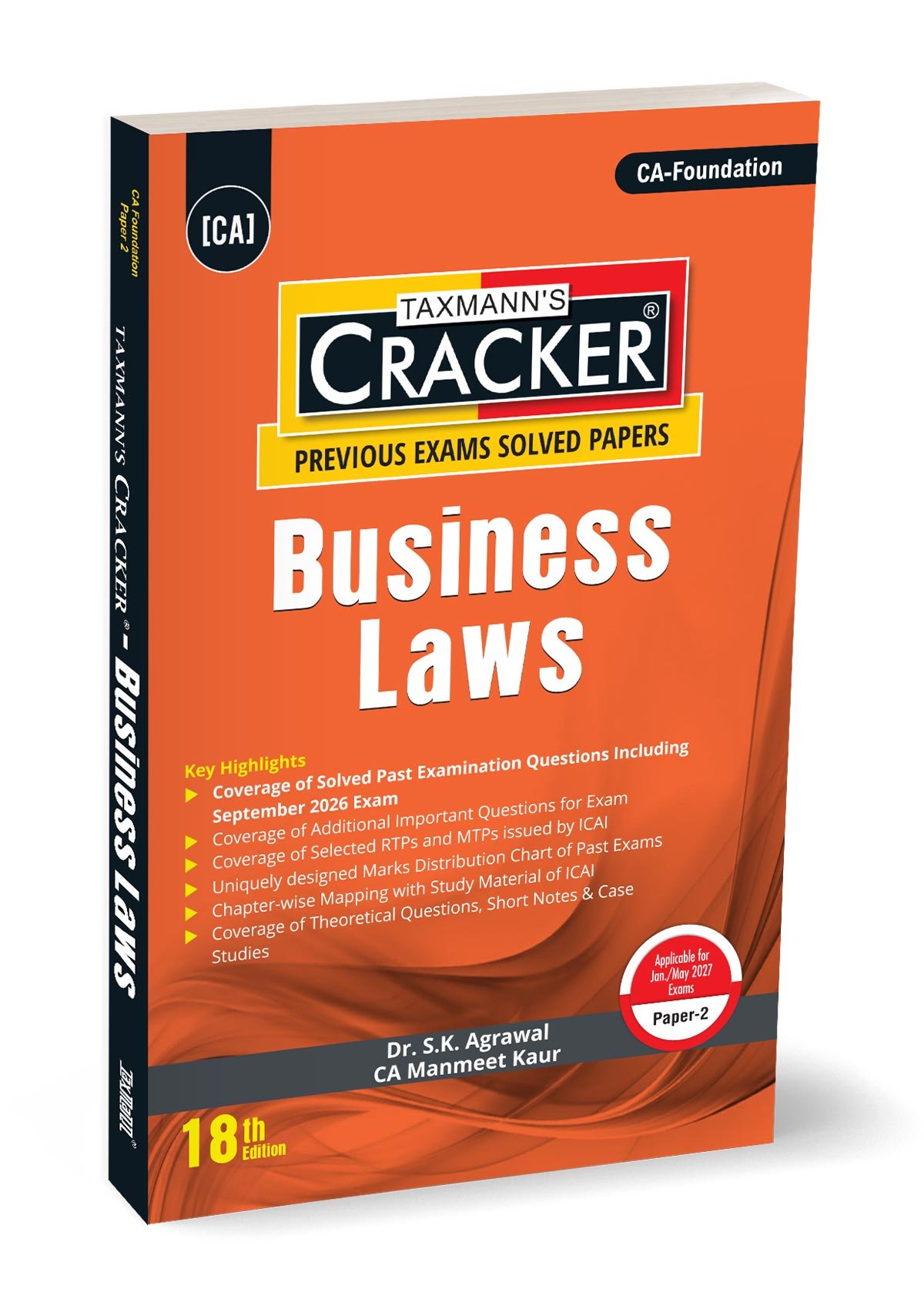
Taxmann CA Foundation Business Laws Cracker By Manmeet Kaur S.K. Agrawal Jan & May 27
Original price was: ₹475.₹380Current price is: ₹380.
Business Laws – CRACKER turns the CA Foundation Paper 2 syllabus into 661 solved questions across 24 chapters, with the answer printed directly below every question. The questions are drawn from past exams and from ICAI’s Revision Test Papers and Mock Test Papers, each tagged with its source, and topped up by the authors wherever the ICAI pool runs thin. Every chapter follows the same order, long answers first, then short answers, then case studies, so practice can be targeted rather than sequential. Case studies form the largest part of the book and are answered in full prose, stating the rule, applying it to the facts and closing with the conclusion. This 18th Edition by Dr S.K. Agrawal & CA. Manmeet Kaur adds a chapter-wise marks chart, a mapping to the ICAI Study Material and the September 2026 paper solved in full.
CA Foundation Business Laws Manmeet Kaur S.K. Agrawal Jan & May 27
CA Foundation Business Laws Manmeet Kaur S.K. Agrawal Jan & May 27
Descriptions –
Business Laws – CRACKER is a solved question bank for Paper 2 of the CA Foundation course. Every page is either a question or its answer. There is no chapter theory, no summary notes and no answer key at the back, because each answer sits right below its question.
The book has 661 questions across 24 chapters. Most of them come from past exams and from ICAI’s Revision Test Papers and Mock Test Papers. Each such question carries a small tag showing where it came from. The rest have been written by the authors to fill the gaps.
Inside every chapter the questions are sorted by type. Long answer questions come first, then short answer questions, then case studies. A few chapters add a differences section. The order never changes, so a reader can go straight to the type of question they want to work on.
Case studies make up most of the book, roughly three questions in five. They are answered the way a problem should be answered. The rule first, then the facts applied to it, then the conclusion. Where a shorter answer is enough, the authors give a Hint instead, which states the rule briefly and the answer.
The answers stay close to the law. They name the section they rely on, and they name the leading judgments where a judgment settles the point. Questions asking for a comparison are answered in a table instead of a paragraph.
The Present Publication is the 18th Edition, authored by Dr S.K. Agrawal & CA. Manmeet Kaur, with the following noteworthy features:
- [Every Question Answered] All 661 questions carry a written answer right below them
- [Sorted by Question Type] Long answers, short answers and case studies are kept in separate sections in every chapter, always in the same order
- [Heavy on Case Studies] Case studies are the largest part of the book, which makes it a practice volume rather than a recap
- [Solved Past Exam Questions] Reproduced in full and placed in the chapter they belong to, up to the September 2026 paper
- [Selected RTPs and MTPs Issued by ICAI] Mixed into the same run of questions, so each chapter reads as one set
- [Extra Questions by the Authors] Added wherever the ICAI pool leaves a chapter thin
- [Source Tag on Each Question] Shows the sitting, the marks and the RTP or MTP it came from. A question asked more than once shows all its sources together, so repeats are easy to spot
- [Alternative Wordings] Where the same point was asked in different words, the other version is printed below the first under OR
- [Proper Written Answers] Case study answers run as full prose, not bullet points
- [Hint Answers] Short answers that give only the rule and the conclusion, for quick revision
- [Comparison Tables] Difference questions are answered in a table with a clear basis of distinction
- [Working Shown] Where a question involves figures, the calculation is set out step by step and totalled
- [Uniquely Designed Marks Distribution Chart] Shows chapter-wise marks over the last ten sittings, split into short answer, long answer and case studies, with compulsory questions marked
- [Chapter-wise Mapping with the ICAI Study Material] Every chapter is matched to its chapter and unit in the Study Material, so both books can be used side by side
- [Solved September 2026 Paper] Answered in full. Where a question repeats one already answered in a chapter, the answer points to that page instead of repeating itself
- [Note on Writing Answers] A short note from CA Manmeet Kaur explains the three-part method used in the answers
The coverage of the book is as follows:
- Unit I | Indian Regulatory Framework
- Unit II | Indian Contract Act 1872, in 13 chapters covering Nature of Contract; Offer & Acceptance; Capacity to Contract; Consideration; Free Consent; Legality of Object & Consideration; Void Agreements; Contingent & Quasi-Contracts; Performance of a Contract; Discharge of a Contract; Indemnity & Guarantee; Bailment and Pledge; and Agency
- Unit III | Sale of Goods Act 1930, in four chapters covering Formation of the Contract of Sale; Conditions & Warranties; Transfer of Ownership; and Unpaid Seller
- Unit IV | Indian Partnership Act 1932, in three chapters covering General Nature of a Partnership; Relations of Partners; and Registration of a Firm & Dissolution of a Firm
- Unit V | Limited Liability Partnership Act 2008
- Unit VI | The Companies Act 2013, the longest chapter in the book
- Unit VII | The Negotiable Instruments Act 1881
- Solved Paper | September 2026
The structure of the book is as follows:
- Unit and Chapter Openers — Each unit opens with a unit page, and each chapter with a numbered chapter page carrying the chapter name
- Questions Grouped by Type — Within the chapter, questions sit under dark banners marking the type: long answer, then short answer, then case studies
- Question in a Shaded Box — Each question is printed in a shaded box with its source tag at the end, and the answer follows straight after
- Answer Shaped to the Question — Numbered points for theory, a table for comparisons, and rule, facts and conclusion for case studies
- Part-wise Answers — Questions with several parts are answered part by part, in the same order they are asked
- Running Page Headings — Page headings carry the unit name on one side and the chapter name on the other
About the authors
CA Manmeet Kaur, an FCA, B.Com, and M.A. (Economics) from Kanpur University, specialises in teaching several key papers:
- Paper 2 – Business Laws & Business Correspondence & Reporting at the CA Foundation Level (formerly Mercantile Law at CPT level)
- Corporate & Other Laws (formerly Law, Ethics & Communication at IPC level) in Group I at the Intermediate level
- Paper 7 – Enterprise Information Systems & Strategic Management (formerly IT/SM at IPC level) in Group II at the Intermediate level
| Weight | 0.62 kg |
|---|---|
| Book Author | Manmeet Kaur, S K Agarwal |
| Binding | Paper back |
| Edition | 18th Edition 2026 |
| HSN | 49011010 |
| ISBN | 9788167011800 |
| Language | English |
| Publisher | Taxmann |
Only logged in customers who have purchased this product may leave a review.
Related products
 Taxmann CA Foundation Business...
Original price was: ₹475.₹380Current price is: ₹380.
Reviews
There are no reviews yet.