
No products in the cart.
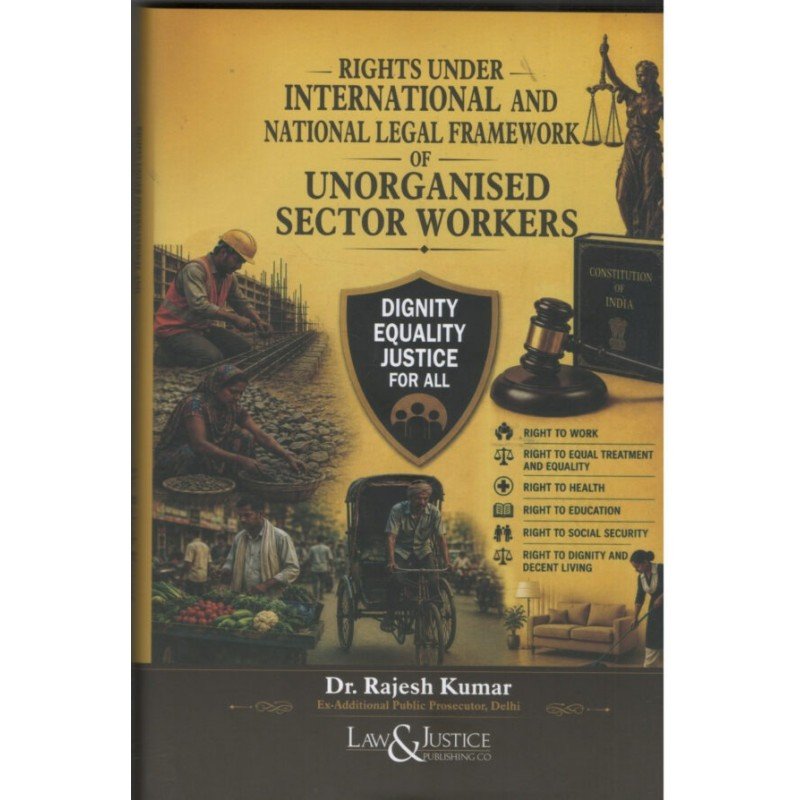
Return To ShopRights Under International & National Legal Framework Of Unorganised Sector Workers
Rights Under International & National Legal Framework Of Unorganised Sector Workers
Description
This academic work offers a comprehensive analysis of the legal, constitutional, and policy frameworks protecting migrant workers and unorganized sector labor, with a specialized case study on the State of Haryana.
Key Chapters & Subject Coverage
- Evolution of the Unorganized Sector: Traces theoretical approaches (Dualistic, Neo-Liberal, Structural Articulation) and historical commission findings on unorganized labor, covering specific categories like construction, casual, contract, and domestic workers.
- International Legal Framework: Examines fundamental human rights jurisprudence, natural law, social contract theory, and major global treaties including the Universal Declaration of Human Rights, ICESCR, ICCPR, ICRMW, and ILO conventions.
- Constitutional & Statutory Protections: Analyzes Indian constitutional provisions (Fundamental Rights, DPSP) alongside central laws such as the Equal Remuneration Act, Bonded Labour System (Abolition) Act, Inter-State Migrant Workmen Act, and state-level Haryana labor legislations.
- Government Policies & Welfare Schemes: Details central and state social security programs, including AABY, AAY, RSBY, IGNOAPS, and specialized sector schemes for weavers, artisans, and street vendors.
- Empirical Analysis (Haryana Case Study): Presents field data on migrant workers in the agriculture and construction sectors, detailing demographic profiles, migration drivers, female worker conditions, and empirical findings.
- Judicial Approaches & Labor Reforms: Reviews key judicial precedents alongside an annexure introduction to the four new Indian Labour Codes (Wages, Industrial Relations, OSH, and Social Security).
| HSN | 49011010 |
|---|---|
| Edition | Edition 2026 |
| Language | English |
| Publisher | Law & Justice |
| Book Author | Rajesh Kumar |
Only logged in customers who have purchased this product may leave a review.
Related products
 Law & Justice Rights Unde...
Reviews
There are no reviews yet.