
No products in the cart.
Return To Shop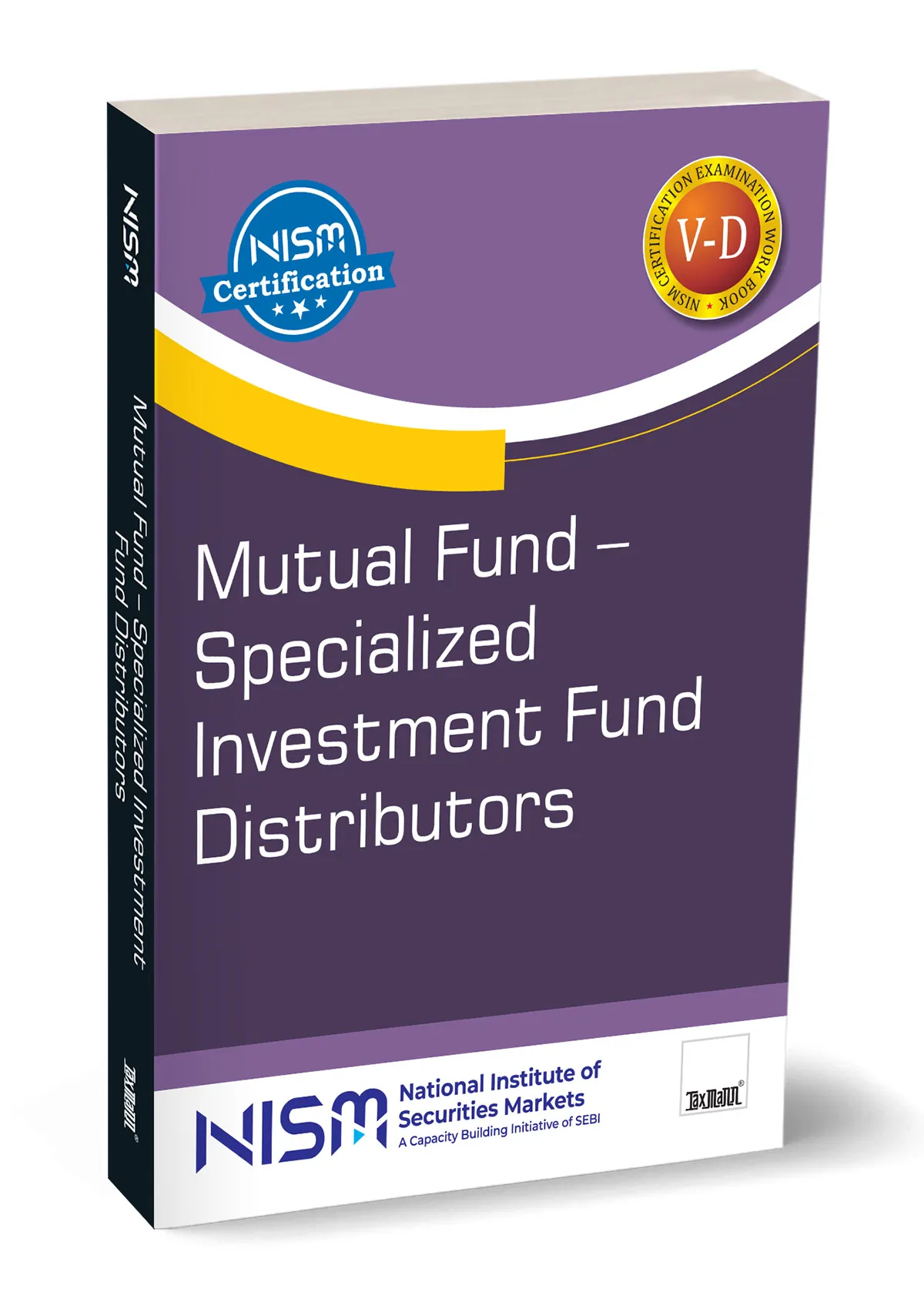
Taxmann Mutual Fund – Specialized Investment Fund Distributors By National Institute of Securities Markets (NISM) | An Educational Initiative of SEBI Edition September 2026
₹1,150
Mutual Fund – Specialized Investment Fund Distributors is the official NISM workbook for the NISM-Series-V-D Certification Examination, published by Taxmann. SIFs run long-short strategies through derivatives, so the book pairs mutual fund distribution with equity and interest rate derivatives in one volume. Its 22 chapters are mapped to the exam’s 150 marks, and each ends with sample questions, 99 in all. Calculations are worked line by line, and 50 trading, hedging and arbitrage strategies are explained. The March 2026 version is current with the SEBI (Mutual Funds) Regulations 2026, and stays useful long after the exam.
Mutual Fund Specialized Investment Fund Distributors Edition 2026
Mutual Fund Specialized Investment Fund Distributors Edition 2026
Description
Mutual Fund – Specialized Investment Fund Distributors is the official workbook prescribed for the NISM-Series-V-D Certification Examination. It has been developed and reviewed by the National Institute of Securities Markets and is published by Taxmann.
The certification has been introduced because the product itself is new. SEBI has established the Specialized Investment Fund, or SIF, as a distinct product line within the mutual fund framework. An SIF carries a minimum investment of ₹10 lakh and operates through long-short strategies executed with derivatives. Distributing such a product therefore calls for two competencies rather than one: a command of the mutual fund business, and the ability to read a payoff chart and size a hedge.
The workbook accordingly brings three subjects together in a single volume. Module 1 sets out the mutual fund distribution syllabus in full. Module 2 covers equity derivatives. Module 3 covers interest rate derivatives. Together, they span 22 chapters and 745 pages of text.
The book is constructed for study rather than for reference reading alone. Every chapter opens with a statement of its learning objectives and closes with a set of sample questions in which the correct answer is marked. Every computation is worked through in full, with the figures shown at each stage, and every strategy is presented with its payoff table, payoff chart and break-even point.
This book is intended for the following audience:
- Individual Mutual Fund and Specialized Investment Fund distributors
- Employees of Organisations engaged in the sale and distribution of SIF
- Employees of Asset Management Companies, particularly those engaged in MF-SIF sales and distribution
- Existing ARN-holders extending their practice from conventional schemes to long-short strategies
- Registered Investment Advisers, Relationship Managers and Wealth Management teams serving clients above the ₹10 lakh threshold
- Product, Compliance, Operations and Risk Personnel at AMCs, registrars and distribution houses
- Treasury and Dealing Personnel at banks, primary dealers, insurance companies and provident funds, for whom Module 3 functions as a standing desk reference
- Students, Job Aspirants, Trainers and Coaching Institutions
The Present Publication is the March 2026 version. It is current with the SEBI (Mutual Funds) Regulations 2026 and the SEBI Master Circular of March 2026, and carries industry data up to February and March 2026. It is veveloped and reviewed by the NISM Certification Team, together with NISM Subject Matter Experts Mr Sundar Sankaran, Ms Sunita Abraham, Mr Amit Trivedi, Mr Joydeep Sen, Dr Aparna Bhat, Mr A. C. Reddi and Mr Sunil M. Gawde, and the Examination Committee constituted for this certification. The noteworthy features of the book are as follows:
- [Prescribed Text] The examination is largely based on this material, and the syllabus is covered in full. No supplementary reading is required
- [Marks Mapped Chapter by Chapter] Each chapter carries a stated weightage in the prelims, and the weightages total exactly 150, being the full mark allocation of the paper. Module 1 accounts for 68 marks, Module 2 for 52 and Module 3 for 30. Preparation time may therefore be allocated against marks rather than against page count
- [Three Subjects in One Volume] Mutual fund distribution, equity derivatives and interest rate derivatives are each treated to examination depth. The separate NISM derivatives workbooks are not required
- [Ninety-nine Sample Questions] All 22 chapters close with a set, with the correct option printed in bold. A substantial number are numerical and follow the pattern of the examination itself
- [Fifty Worked Strategies] Chapter 17 demonstrates twenty-five equity positions and Chapter 22 a further twenty-five interest rate positions. Each is accompanied by a payoff table, a payoff chart, a maximum profit, a maximum loss and a break-even
- [Computations Shown in Full] Net asset and NAV build-ups, expense ratios, load and taxation workings, measures of return and risk, hedge ratios, arbitrage profits, bond prices, duration and convexity are all carried through step by step, allowing the reader to reproduce the result rather than accept it
- [Spreadsheet Functions Named] The compounding and CAGR formulation, the variance and standard deviation functions, the square root convention for annualisation, and the yield function for yield to maturity are each identified. This is material, since NISM advises that test centre workstations are equipped with either Microsoft Excel or LibreOffice
- [The SIF Regime is Integrated] Its provisions appear in the six chapters they actually govern: the product and its permitted strategies in Chapter 2, AMC eligibility in Chapter 3, investment limits and branding in Chapter 4, risk and portfolio disclosure in Chapter 5, distributor eligibility in Chapter 6, and the investment threshold and transaction rules in Chapter 9
- [Amended & Updated] The text proceeds on the 2026 Regulations and the March 2026 Master Circular. It incorporates the full trail commission model, the capital gains regime as revised in July 2024, the reconstituted expiry-day and contract-size framework for equity derivatives, and the 2025 changes to nomination, KYC and the government securities market
- [Codes of Conduct Reproduced in Full] The statutory Code of Conduct for asset management companies and trustees, the AMFI Code of Ethics and the AMFI Code of Conduct for Intermediaries are printed as appendices, so that the provisions are read in the original rather than in summary
- [A Single Footnote Series of 136 Notes] The notes carry circular references, live SEBI, RBI and AMFI sources, definitions and cross-references to related sections
- [Continued Reference Value] The cut-off time table, the turnaround time table, the expense ratio slabs, the benchmark maps, the taxation tables and the complete set of contract specifications remain useful in practice long after the examination
The coverage of the book is as follows:
- Module 1 | Mutual Fund Distributors
- Investment Landscape — Financial goals and the effect of inflation upon them, the principal asset classes, the types of investment risk, behavioural biases in decision making, risk profiling, asset allocation and rebalancing, and the case for investing through a mutual fund
- Concept and Role of a Mutual Fund — The nature and role of a fund, its advantages and limitations, open-ended, close-ended and interval structures, active and passive management, SEBI’s scheme categories in full, the newer product types including the Specialized Investment Fund and its permitted strategies, and the growth of the Indian industry.
- Legal Structure of Mutual Funds in India — The trust structure, the roles of the sponsor, trustees, asset management company and custodian, the internal organisation of an AMC, the service providers surrounding a fund, and the function of AMFI
- Legal and Regulatory Framework — The regulators, SEBI’s rulebook mapped head by head, permitted investments and investment restrictions, the advertisement code, investors’ rights, distributor due diligence, grievance redress, and the AMFI codes
- Scheme Related Information — The SID, SAI and KIM, fundamental attributes, NAV and expense ratio disclosure, the scheme performance dashboard, the Risk-o-meter and the SIF Risk-Band, portfolio, financial and annual disclosures, and the fund factsheet
- Fund Distribution and Channel Management Practices — The distribution channels and their operation, exchange and digital platforms, the requirements for becoming a distributor, distributor remuneration, commission disclosure, due diligence, the distinction between a distributor and an investment adviser, nomination, and change of distributor
- Net Asset Value, Total Expense Ratio and Pricing of Units — Fair valuation, computation of net assets and NAV, mark to market, the expenses chargeable to a scheme and the limits upon them, valuation of perpetual bonds, distributable reserves, loads, accounting and reporting requirements, and segregated portfolios
- Taxation — Taxation at the level of the fund and of the investor, capital gains and holding periods, grandfathering, IDCW, stamp duty, set-off and carry-forward, Securities Transaction Tax, Section 80C, tax deducted at source, and GST
- Investor Services — The NFO process, plans and options, allotment and account statements, investor eligibility, the application form field by field, payment mechanisms, cut-off timing and time stamping, KYC together with FATCA and CRS, systematic transactions and triggers, nomination, pledge, dematerialisation and transmission, changes in status for minors, non-residents and Hindu Undivided Families, turnaround times, unclaimed assets, and the voluntary lock-in facility
- Risk, Return and Performance of Funds — General and scheme-specific risk factors, the drivers of performance in equity, debt, gold and real estate funds, the measures of return, the distinction between scheme returns and investor returns, the measures of risk, and the provisions governing credit risk, gating and side-pocketing
- Mutual Fund Scheme Performance — The requirements of a credible benchmark, price return against total return, benchmarks by scheme type, the two-tier benchmarking structure, the Sharpe and Treynor ratios, alpha and the information ratio, tracking error, and the sources of performance disclosure
- Mutual Fund Scheme Selection — Matching the scheme to the investor, the core and satellite construct, risk-return hierarchies across fund types, selection by investment strategy, an eight-point checklist for choosing between schemes, the correct reading of agency ratings and rankings, the choice of option, and the do’s and don’ts
- Appendices to Module 1 — The statutory Code of Conduct for asset management companies and trustees; the AMFI Code of Ethics; the AMFI Code of Conduct for Intermediaries of Mutual Funds; and a list of twelve further resources
- Module 2 | Equity Derivatives (52 marks)
- Basics of Derivatives — The nature of a derivative, the development of the Indian market, the four generic products, the roles of hedgers, traders and arbitrageurs, exchange-traded against over-the-counter markets, and the risks borne by participants
- Understanding the Index — Index construction under four methodologies, liquidity, bid-ask spread and impact cost, index management and revision, the principal Indian indices, and the applications of an index
- Introduction to Forwards and Futures — Forward contracts and their limitations, futures contracts and their specifications, basis, cost of carry, margins and open interest, payoff charts, futures pricing, convergence at expiry, and the use of futures for hedging, trading and arbitrage
- Introduction to Options — Calls and puts, contract specifications, moneyness, intrinsic and time value, payoff charts for all four basic positions, the distinction from futures, the five pricing parameters and the five Greeks, the binomial and Black-Scholes models, implied volatility, and the positions of the buyer and the seller
- Strategies using Equity Futures and Equity Options — Twenty-five worked positions, comprising hedges with stock and index futures, directional trading with futures, cash-and-carry and reverse arbitrage, calendar spreads, four vertical spreads, straddles and strangles, the covered call, collar and butterfly, the protective put, put-call parity arbitrage and delta hedging, followed by the interpretation of open interest and the put-call ratio
- Module 3 | Interest Rate Derivatives (30 marks)
- Introduction to Interest Rate, Interest Rate Instruments and Fixed Income Market — The determinants of interest rates, the types of fixed income security, the risk-free rate, the term structure and its shifts, day-count conventions, accrued interest, coupon, current yield and yield to maturity, bond valuation, duration, PV01 and convexity, and the Indian debt market together with its platforms and regulators
- Interest Rate Derivatives — The nature and economic role of these instruments, forward rate agreements, bond forwards, futures, options, caps, floors, collars, swaps and swaptions, market size, the participants, and the comparison of over-the-counter with exchange-traded contracts
- Exchange Traded Interest Rate Futures — The operation of these contracts in India, payoff charts, complete specifications for GOI bond futures, 91-day Treasury Bill futures, Overnight MIBOR futures and corporate bond index futures, lot size, tick size and tick value, and the computation of price
- Exchange Traded Interest Rate Options — Option fundamentals applied to a bond, exercise styles and moneyness, the five pricing parameters and the five Greeks each demonstrated on a live security, put-call parity, the binomial, Black-Scholes and Black 1976 models, implied volatility, payoff diagrams, contract specifications, and market indicators
- Strategies using Exchange Traded Interest Rate Derivatives — Twenty-five worked positions, comprising short and long hedges, duration-based portfolio hedging, the hedging of a future borrowing, four vertical spreads, straddles and strangles, the covered call and protective put, the butterfly, directional trading, alteration of portfolio duration, regular and reverse arbitrage, synthetic securities, calendar and inter-bond spreads, and the limitations of these instruments as a hedge
Every chapter follows the same template, which is what makes 745 pages navigable under examination conditions.
- Learning Objectives — A ruled box at the head of each chapter states what it is intended to teach. Its contents correspond to the numbered sections that follow, so it also serves as a revision checklist
- Numbered Sections — Principal sections are numbered by chapter and set in a shaded bar. Sub-sections are numbered decimally and run to three, and occasionally four, levels, so cross-references resolve without recourse to the contents page
- Worked Illustrations within the Text — Examples are not set apart in boxes. The situation is stated, the objective or risk identified, and the arithmetic then performed line by line. Where more than one outcome is possible, each is labelled and worked separately
- Tables, Charts and Formulas that Carry the Working — Tables reconcile a computation to its result or lay out a payoff across a range of prices, and each payoff chart is placed beneath the table from which it is derived, followed by a short passage reading it back in words. Formulas are displayed on their own line, with the terms defined below and the substituted values shown alongside
- A Continuous Footnote Series — The notes run without interruption from note 1 to note 136, carrying sources, definitions and cross-references
- Sample Questions at the Close of Every Chapter — Set in a ruled box, with options lettered (a) to (d) and the correct option in bold. All 22 chapters carry a set, amounting to 99 questions
| Weight | 1 kg |
|---|---|
| Book Author | National Institute of Securities Markets (NISM) | An Educational Initiative of SEBI |
| Binding | Paperback |
| Edition | Edition 2026 |
| HSN | 49011010 |
| Language | English |
| Publisher | Taxmann |
Only logged in customers who have purchased this product may leave a review.
Related products

 Taxmann Mutual Fund – Speciali...
Reviews
There are no reviews yet.